
STXBP1
c.1217G>A (p.Arg406His)
These counts describe this STXBP1 example. Reports for other genes will differ — a long-studied gene surfaces more published work than one described recently.
Family Summary
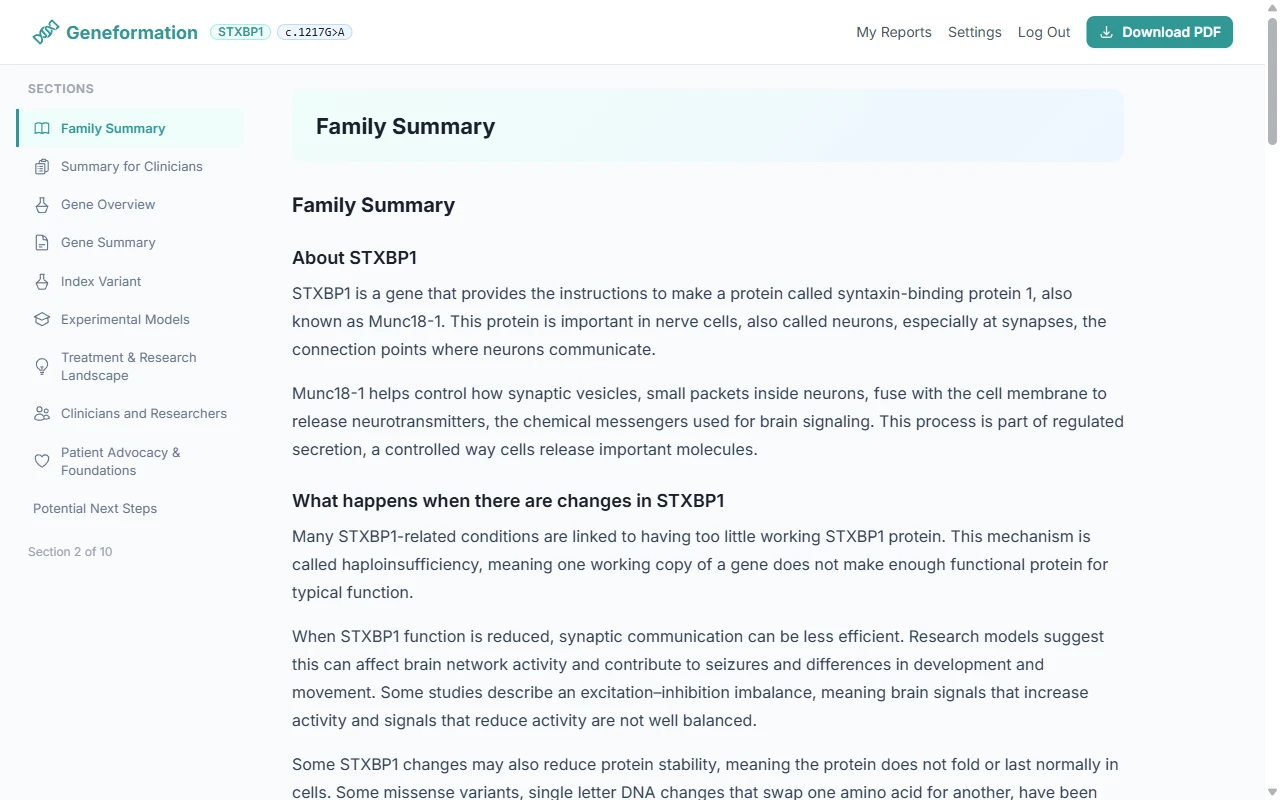
Section 1 of 10About STXBP1 — STXBP1 is a gene that tells the body how to make a protein called syntaxin-binding protein 1 (also called Munc18-1). This protein is found at the connections between nerve cells in the brain, called synapses, where messages are passed from one nerve cell to another. STXBP1 is especially active in the brain, including the cerebral cortex, and is mainly present in nerve endings where it helps control the release of chemical messengers, called neurotransmitters, between brain cells.
What happens when there are changes in STXBP1 — Changes in STXBP1 can reduce the amount of working STXBP1 protein or make the protein less stable or less able to do its job. When STXBP1 is not working properly, nerve cells have trouble releasing neurotransmitters in a normal way. This can disturb the balance between "exciting" and "calming" signals in the brain, which can affect how brain networks develop and work, and can lead to developmental delay, difficulties with movement, and seizures.
STXBP1-related conditions — Changes in one copy of the STXBP1 gene are linked to:
- STXBP1-related encephalopathy with epilepsy, a brain disorder with developmental delay and seizures.
- Developmental and epileptic encephalopathy 4 (DEE4), an early-onset epilepsy and developmental disorder.
- A broader STXBP1-related neurodevelopmental disorder spectrum.
Common features — The full Family Summary groups reported clinical features into four areas, each with plain-language detail:
The summary also covers inheritance, investigations highlighted, current clinical care, potential therapeutic approaches, community and connections, the clinicians and researchers working on this gene, and the reported variant with its functional data.
Screenshot from the actual report dashboard:
Summary for Clinicians
Section 2 of 10STXBP1 NM_001032221.6:c.1217G>A (p.Arg406His) is classified in ClinVar as Pathogenic or Likely pathogenic, multiple submitters, no conflicts. This missense change affects domain 3b of Munc18-1.
p.Arg406Cys/His is a reported hotspot — 40 of 534 individuals (7%) in a harmonized STXBP1-related disorder cohort. Variant-specific functional data for R406H include protein instability and aggregation, with coaggregation of wild-type protein.
The section is organised for clinical review: decision-relevant considerations, key clinical features, mechanism and genotype–phenotype notes, and management information.
Gene Overview
Section 3 of 10Gene Summary
Section 4 of 10Associated Disorders & Clinical Features
Pathogenic variants in STXBP1 are associated with a spectrum of neurodevelopmental disorders, collectively referred to as STXBP1-related disorders. The spectrum spans developmental delay with or without epilepsy; epilepsy is common but not universal. Reported seizure presentations include neonatal and infantile onset, epileptic spasms, focal seizures, and generalized tonic–clonic seizures, with EEG findings that can include burst suppression.
Protein Structure and Function
STXBP1 encodes the Munc18-1 protein, essential for synaptic vesicle exocytosis, acting as a template for SNARE complex assembly at presynaptic terminals. The protein adopts an arch-shaped conformation with three domains that bind syntaxin-1A in both closed and open conformations (Misura et al., 2000).
Pathomechanisms
Across STXBP1, haploinsufficiency — reduced functional protein dosage — is described as a major disease mechanism, supported by loss-of-function variants, deletions, and dose-sensitive model systems. Some missense variants additionally show protein instability and aggregation, and in reports on this variant the altered protein can recruit wild-type protein into insoluble aggregates.
Variant Analysis
Section 5 of 10Location & impact: This variant changes position 406 from arginine to histidine in domain 3b, a region critical for syntaxin-1A binding. In a large cohort of 534 individuals, changes at this position (Arg406His and Arg406Cys) were seen in 40 individuals, making it a recurrent hotspot.
Functional evidence: In a multi-model study of disease-linked Munc18-1 missense variants that included R406H, the altered protein was reported to recruit normal Munc18-1 into insoluble aggregates, and chemical chaperones were reported to stabilise protein levels and reverse that insolubility (Guiberson et al., 2018). In a separate pharmacological-chaperone study, structure-based compounds were reported to increase R406H stability in cellular assays, with rescue in synaptic readouts in neurons expressing the variant (Abramov et al., 2021). In a humanized C. elegans model expressing human STXBP1 variants, R406H protein abundance was reported at roughly 20–30% of wild-type levels (Zhu et al., 2020).
Variant-specific considerations: Approaches that increase protein stability or prevent aggregation may be particularly relevant to this variant's mechanism.
Experimental Models
Section 6 of 10Multiple animal and cellular models have been established to study STXBP1 function and disease mechanisms:
- Haploinsufficient mouse models — including cell-type-specific versions that remove one copy only in excitatory or only in inhibitory neurons.
- Base-edited cynomolgus monkey carrying STXBP1 p.Arg292His — a non-human primate model of a comparable missense change.
- Patient-derived iPSC neurons, including pure GABAergic neurons with isogenic CRISPR-corrected controls, and knockout lines used to test AAV rescue.
- Humanized C. elegans variant panel on an unc-18 null background, used to compare individual variants directly.
- Zebrafish and Drosophila models — stxbp1a/stxbp1b mutants and Rop haploinsufficiency.
Treatment & Research Landscape
Section 7 of 10This report compiled 35 entries across 7 categories — treatments, research programmes and studies:
Plus drug repurposing candidates, dietary and nutritional management, and other approaches. Registries and natural-history studies are listed here as research opportunities, not as treatments.
Each entry includes its type and development stage, a description of the approach, the evidence behind it, how it relates to your variant class, and links to ClinicalTrials.gov, PubMed or the original source.
Example entries from this report:
CAP-002 (Capsida Biotherapeutics)
A gene replacement approach given as a one-time infusion, intended to add a working copy of STXBP1. It entered an interventional Phase 2 trial in children; the registry now lists that trial as terminated, so it is not currently enrolling.
ClinicalTrials.gov NCT06983158
Glycerol phenylbutyrate (Ravicti)
Being evaluated in an open-label pilot interventional study that enrolls people with STXBP1 encephalopathy, assessing safety and tolerability with exploratory seizure and EEG outcomes. The report lists 4-phenylbutyrate itself separately, as a preclinical chemical-chaperone strategy aimed at the protein instability reported for this variant.
Levetiracetam
An antiseizure medication already in wide clinical use, reported in STXBP1 cohorts on observational evidence rather than controlled trials in this gene. The report states the evidence type so the strength of each option is visible.
The section also includes a Potential Therapeutic Avenues analysis specific to the gene and variant mechanism.
Screenshot from the actual report dashboard:

Clinicians & Researchers
Section 8 of 10This report identified 22 clinicians and researchers with published work related to STXBP1, organized into 3 groups:
Clinicians with published experience managing STXBP1-related epilepsy and developmental outcomes.
Investigators leading clinical trials, cohort studies, and translational research relevant to STXBP1.
People coordinating natural-history programmes, registries and biobanking efforts.
For each person, the report includes: name, credentials, role, institutional affiliation, a narrative description of their work and contributions, links to key publications, and profile links.
Screenshot from the actual report dashboard (names blurred for privacy):

Patient Advocacy & Foundations
Section 9 of 10This report identified 18 advocacy organizations worldwide, including:
And eight more — national groups in Canada, Poland and Slovakia, Fundación Lukiss, Rafa’s Moonshot, and three parent-run Facebook communities.
Each organization includes a description, website link, email contact, and social media links where available.
Screenshot from the actual report dashboard:

Potential Next Steps
Section 10 of 10Practical conversation starters drawn from what this report found — options for the clinical team to discuss with the family, not instructions. The section groups them into five themes:
- Understanding the variant's effect — what the functional evidence for this specific change does and does not establish, and why that shapes which research directions are worth tracking.
- Therapeutic directions to discuss — the symptom-targeted options named in the report, each with its evidence type, plus the current registry status of any study mentioned.
- Monitoring and clinical care — the investigations and follow-up the literature describes for this gene.
- Research participation — registries and natural-history studies, with their recruitment status and what taking part involves.
- Community and advocacy — which organizations are reachable, and where the report could not identify a single best contact.
Each theme ends with a suggested question to raise at the next clinic visit.
Read the complete report
Everything above is an excerpt. The full STXBP1 c.1217G>A report is published in the same dashboard customers use — every section, every citation, every link.
Open the full reportIndividual researcher email addresses are removed from this public copy.
Generate a report for your gene and variant
Every report is tailored to the specific gene and variant you provide, drawing from current scientific literature and biomedical databases. Reports follow the structure shown above, with full, unabridged content in each section.